Tansi Kiawow! Thank you for your interest in my work.
paintings • beaded art • beaded blankets • tea towels • pillows
Tansi Kiawow! Thank you for your interest in my work.
paintings • beaded art • beaded blankets • tea towels • pillows
I have been transforming this piece for a decade - yes a decade! Now it is complete. The lake shape and tributaries are from a vintage map of Buffalo Lake near Stettler, Alberta, a well known historical Metis settlement. I love that the map cartographer took liberties when recording the shape of the lake to make it appear more Buffalo-like! Jacques Cardinal recorded my ancestors wintering over at this location in the late 1800’s. This piece is acrylic, charcoal and e-sized beadwork on deer hide stretched and framed with a simple black wood frame.
Beaded map from a 1970’s book featuring various Canadian tourist stops at that time. Batoche is an historical site that used to house 500 Métis residents. It was depopulated after its residents fought in 1885 for cultural rights; to continue to live according to their unique identity and way of life. Now Métis people gather there each summer for a cultural festival called “Back to Batoche”. I added the beaded flower pattern from the top right corner of the map, to the bottom left. This symbolizes the movement over time of certain Métis families as they journeyed from Eastern Canada to Western Canada, and the return of Métis people to this site each year to celebrate their culture. Flower beadwork is an expression of a worldview that values connection to nature as nature provides all that is needed to live a good life. Métis were historically called “The Flower Beadwork People” by other indigenous groups. This beaded vintage map is mounted on painted deer hide (parfleche), that was processed by the artist according to teachings from her elders.
A duet between a 1950’s vintage McCalls Pattern 2379 and Metis beaded floral work.
In the Artist’s personal collection.
A photo of my father’s family on vacation in 1956 is the inspiration for this blanket. The photo was taken in Blairmore, Alberta. Of all our belongings, blankets are the ones who carry memories that are made close to our hearts. They keep us warm when we are sick, they comfort us when we are tired. They are sometimes carried for security and sometimes for honour. New life might begin under a blanket, then follow that person through their seasons and into to the next generation. Blankets shape-shift to accommodate our requests - whether worn, draped or hung on a wall.
NFS - This blanket is part of my personal collection.
Cotton Story Blanket - wall hanging
Date Created: 2012
Medium: Beaded, woven cotton blanket created from original photo-and digital painting. Size: 72" x 56"
With this piece I am inviting viewers to think about what they no longer believe. In the 1970’s, Encyclopedia Britannica, once accepted as an authority on education, politics and economics, incorrectly predicted the assimilation of Indigenous peoples and the extinction of their Natural Law. My piece, featuring a beaded 1970’s encyclopedia page mounted on a cow skull, is a continuation of with my body of work on counter mapping. I’ve beaded and redacted false information to counter ideas like extinction, assimilation and the abandonment of Indigenous Natural Law (reliance on animals like the buffalo for raw materials). The article asserts that Indigenous worldview and land stewardship were savage and obsolete, the plants and animals on this continent insufficient, and therefore were replaced with settler food, animals like the cow, plants, economics, and ideas. All were imported with the belief that they would improve life for everyone.
Beaded Metis floral work on vintage encyclopedia paper, canvas, acrylic paint. Size is 18”x9”x6.5”. This piece comes with a sturdy wall mount.
There once was reciprocity between the buffalo and the Métis people so when the people communicated their needs with feet vibrating on the land - the buffalo feeling this in their own feet would respond through their actions. The buffalo of today no longer respond, but somewhere in their past, they remember.
I chose to weave my drawing into a blanket for this piece, being that blankets are a symbol of protection. The buffalo and his surroundings were originally drawn by me with charcoal and acrylic paint. Some of the marks on his body and in the background are without a specific direction, symbolizing the path of the herds from overabundance to the near extinction of today. This drawing was then digitized by me and woven into a cotton-thread blanket by a jacquard weaving machine. I applied beadwork to the blanket to honour the historic relationship between the Métis and the buffalo. Some of the beads were placed in the buffalo’s thought bubbles where they represent interference in the modern-day buffalo’s ability to connect with the people.
Cotton Story Blanket - wall hanging
Date Created: 2016
Medium: Beaded, woven cotton blanket created from original painting. Size: 56" x 72"
Hand strung 13" deer skin hand drum - original design inspired by 'grandmother' beadwork, painted with acrylics. Comes with hand built drumstick.
Own one of only 5 high quality Giclee (Zhee-klay) prints of this beaded map from my counter mapping series. (print is 16x20 in.) The original is beaded on a vintage map from a 1950’s Dent Canadian School Atlas. They walk a well beaten path original beadwork piece is a part of the Canadian Indigenous Art Centre collection.
Prints are acid and lignin free and have an archival quality of over 200 years, and come with a certificate of authenticity.
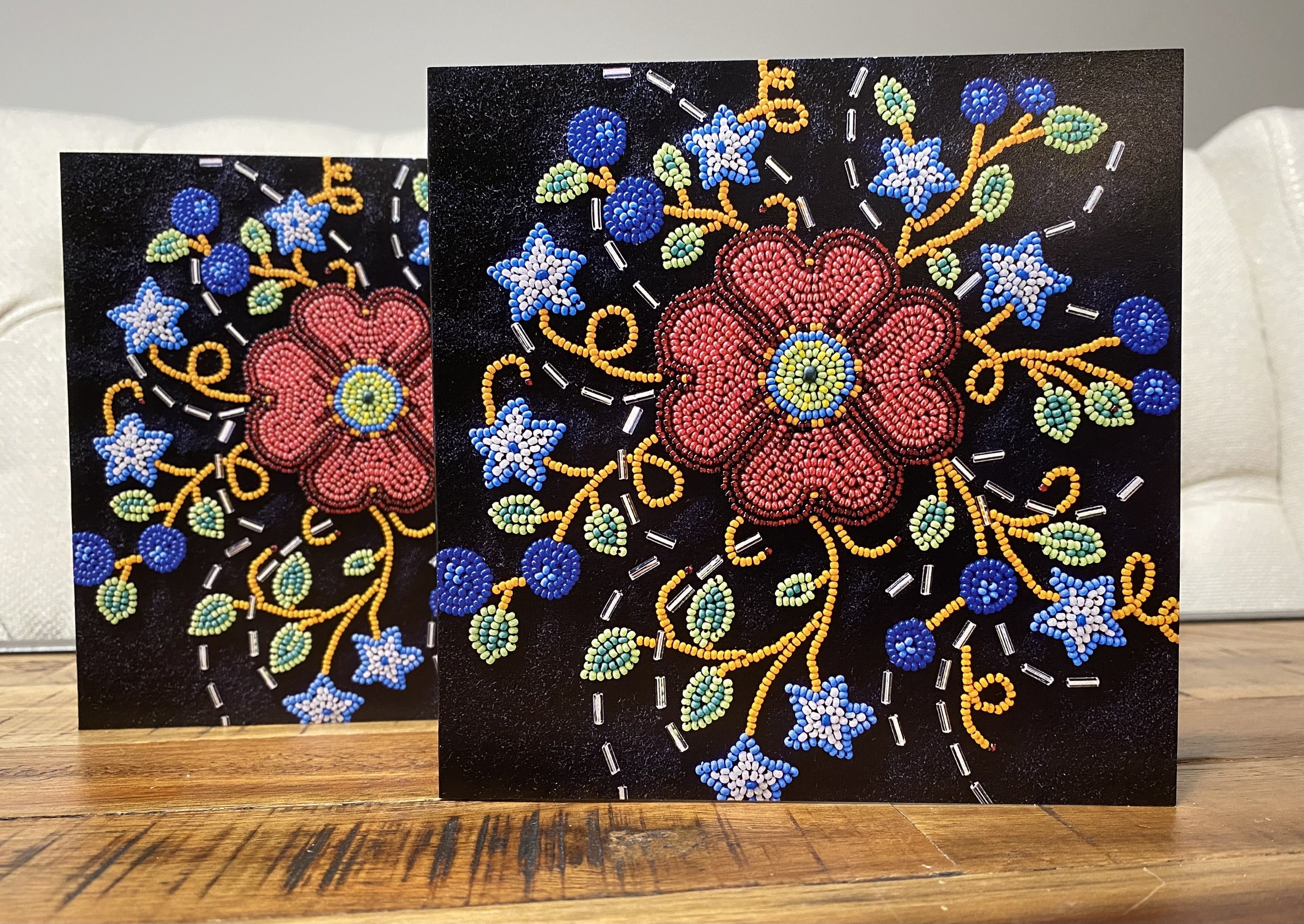
Wild rose and blueberries - a prairie garden from my youth. Blank greeting cards in packs of 4. Blank inside. Cards comes individually wrapped and include an envelope.
Daisy pastel sketch on black paper, framed in a white weathered wood frame. 11.25"x9"x.25".
Daisy pastel sketch on black paper, framed in a white weathered wood frame. 9.5"x7.25"x.5".
Purchasing this digital gift card creates a unique code. The gift card recipient can enter this code at checkout to subtract the gift card value from their order total.
This gift card never expires.




As I wrestle with quantum physics theories around vibration, observation and intention, it makes me wonder how human political activities affect the land.
Beaded and drawn on a 1950’s ledger cover, this piece asks questions about stewardship, about ownership, about claims people make when labeling, recording words on paper, or speaking about the land. In which way (if any) does the land know what is being asked of it?
The map at the top of the piece is my representation of Edmonton Settlement map of 1882 that shows plots along the North Saskatchewan River in Edmonton, Alberta. My Gr. x2 Grandfather, George Gullion and his brother James Ingram Gullion held two plots (34, and 32) at the top.
(Pencil crayon, deer hide, acrylic paint, ‘E’ beads and crow beads on a 14 × 17 “ vintage 1950’s ledger cover)